
Most postnatal nutrition advice stops at six weeks. The baby is here, the appointments taper off, and the assumption is that everything settles. In practice the first year asks something different of you at every stage, and what works at week two is rarely what works at month nine. This is that year walked through stage by stage, written the way I talk it through with women as a postpartum dietitian in Australia, so you can skip straight to the part you are actually in.
None of what follows is a plan to follow. It is a set of things worth noticing, and a few points where it is worth asking someone.
Weeks one to six: recovery
The first six weeks are not the time for a meal plan. Your body is healing from birth, sleep is broken, and the day has no shape at all. Food in this window has one job, which is to be available.
Four things are worth keeping within reach: something with energy in it, something with protein, something with iron, and water. That is the whole list. If you are breastfeeding, thirst tends to arrive suddenly and at the least convenient moment, so a full glass or bottle wherever you feed is more useful than any advice about litres.
What tends to happen instead is that eating slips by accident. Not by choice, and not because anyone decided to skip a meal. Someone hands you the baby, the toast goes cold, and by the time you look up it is three in the afternoon. I have written separately about what to eat after birth when you have no time to cook, which covers the one-handed, cold, two in the morning end of this properly.
The other thing worth knowing in these weeks is that you do not need to earn a meal, and there is no stage of this where eating less is the point.
Weeks six to sixteen: the invisible middle
The six week check happens, you are discharged, and the support quietly drops away at exactly the point the novelty does too. Feeds are still frequent, nights are still broken, and there is now a general expectation that you are back to normal.
This is the stretch where eating patterns set. If breakfast has been a handful of whatever was nearest for eight weeks, that becomes the habit rather than the emergency. The useful move here is to choose one meal, usually breakfast, and make that one meal sit down and complete. Not all three. One. A single reliable meal does more for a broken day than three aspirational ones.
It is also the stretch where tiredness stops being obviously explained by the newborn phase and starts being worth a question. Some of it is broken sleep. Some of it is iron, some of it is simply not eating enough across the day, and some of it belongs with your GP rather than with food. Telling those apart is worth doing rather than assuming. I have written about postnatal iron and energy for exactly this window.

Four to six months: solids start, and your own meals get skipped
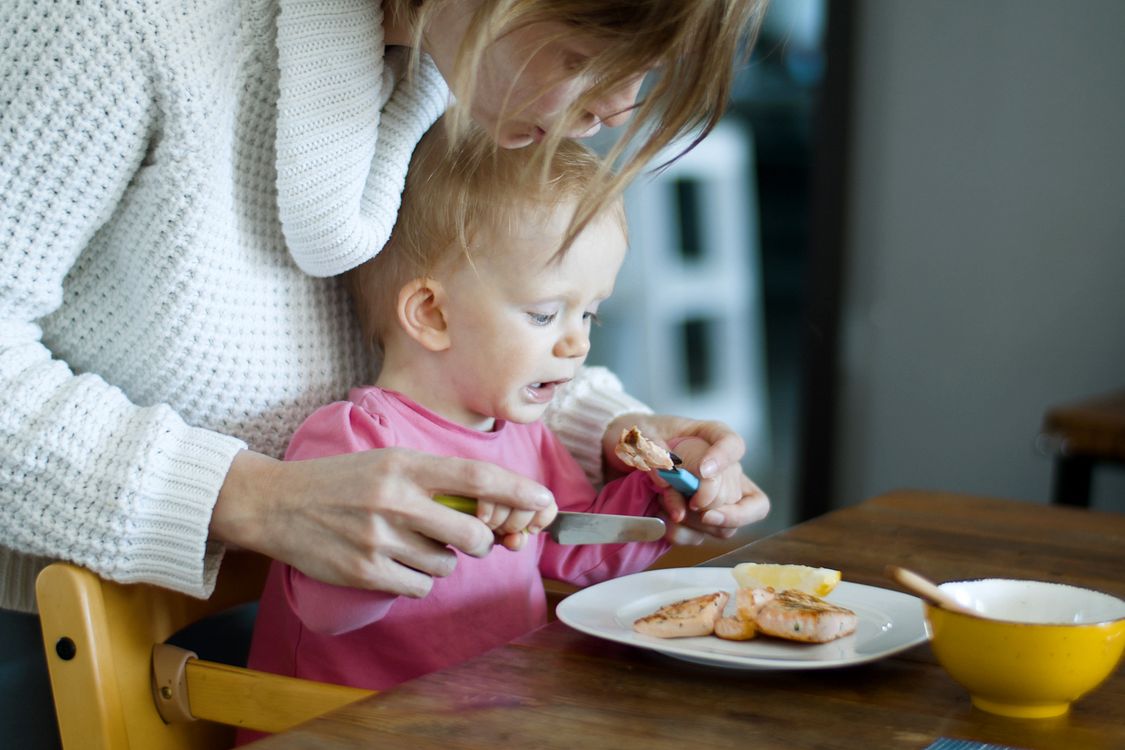
Starting solids adds a whole new category of work. There is purée or there is baby led weaning, there is the mess, there is the washing, and there is the sudden requirement to think carefully about someone else’s iron.
A common pattern at this stage is that a woman’s own eating goes backwards while her baby’s improves. Meals become whatever is left on a high chair tray, eaten standing up. It is completely understandable and it is worth naming out loud, because you are still recovering, possibly still feeding, and now cooking twice.
The practical fix is usually overlap rather than more cooking. A great many first foods are foods you eat too. Roasted vegetables, well cooked lentils, soft fruit, plain yoghurt, scrambled egg, slow cooked meat. Cooking one thing and serving it two ways is less work than cooking two meals, and it means you actually eat one of them.
If you would rather work this out with someone instead of by trial and error, you can book a free 15 minute callback and we can talk through where you are.
Six to twelve months: back at work, still feeding
Returning to work while still feeding is one of the harder stages, and the difficulty is usually logistics rather than nutrition. Expressing at work, timing feeds around a commute, and finding something to eat at a desk between meetings is a scheduling problem long before it is a food problem.
Two things help. The first is deciding in advance what lunch is, because a decision made on a Sunday is a decision you do not have to make at midday with a full inbox and twenty minutes. The second is keeping something in a drawer that needs no fridge and no kitchen, so that a skipped lunch does not turn into a skipped afternoon and a very ordinary evening.
If your supply changes when you go back, that is worth raising with a lactation consultant or your GP alongside looking at food. It is rarely one variable, and food is only ever part of the picture.
Weaning, and what changes for you
Weaning tends to be written about entirely from the baby’s side. From yours it is a change in appetite, often a change in how you feel, and both can arrive without much warning.
Appetite can shift when feeds reduce, which makes sense. What is worth watching is whether it drops further than that change accounts for, particularly if you are also tired or your periods have returned. Iron and energy are worth revisiting at this point rather than assuming the postnatal chapter has closed. Your GP can arrange bloods if that seems useful, and the food side is where I come in.
If weight or body image is sitting heavily at this stage, that is a conversation worth having with someone rather than working through on your own. It is not something to solve with a stricter version of whatever you are already doing.
The one thing that helps at every stage
If there is a single thread running through the whole year, it is that eating well after birth is a logistics problem far more often than a knowledge problem. Most of what is needed here is already known. What is usually missing is a system that survives a bad night.
So the more useful question is not what should I eat. It is what can I actually eat, in this house, this week, with this baby, at three in the afternoon when nothing has gone to plan. That question has a different answer at every stage above, and it is worth answering out loud with someone who works on it every day.
I am an Accredited Practising Dietitian and I work with women through fertility, pregnancy and the first year after birth by telehealth right across Australia. If any stage above sounds like the one you are in, you can read more about postnatal nutrition support, or book a free 15 minute callback and we can work out together whether it is worth doing properly.
Kat xx