The first trimester is the stretch where the advice and the reality part company. You are told to eat well for the baby, and meanwhile the smell of the kettle is enough to send you back to bed. So this is the practical version: what breakfast is actually for in the first twelve weeks, and what to do on the mornings when almost nothing is going in.
I am Kat, an Accredited Practising Dietitian (APD) working in fertility, pregnancy and postpartum nutrition, Brisbane based and consulting across Australia by telehealth. This is general information rather than advice for your own situation.
Why breakfast does more work in the first trimester than it gets credit for
Early pregnancy is not when your energy needs jump. What changes is the density. The same plate has to carry more folate, more iodine and more iron than it did three months ago, and it has to do it through a window where your appetite is unreliable and your tastes have gone strange.
The NHMRC Nutrient Reference Values put the pregnancy recommended dietary intake for folate at 600 micrograms a day, iodine at 220 micrograms, iron at 27 milligrams and calcium at 1000 milligrams. Breakfast is the meal best placed to do a chunk of that quietly, because it is the most repeatable meal of the day. Most of us are creatures of habit before nine in the morning, and a habit is the cheapest nutrition change there is.
The other reason I care about breakfast in the first trimester is that it is often the only meal that happens before the nausea builds. For a lot of women the morning is the good window, and spending it on tea and a dry biscuit is a missed opportunity. If you want the straightforward list of ideas, I have written one for breakfast ideas for pregnant women in Brisbane. This piece is the first trimester version, where nausea changes the brief.
When nausea is running your morning
First, the reassurance, because almost nobody is given the numbers. An Australian study cited in the SOMANZ guideline on nausea and vomiting in pregnancy found 72 per cent of women reported it, with 42 per cent classified mild and 55 per cent moderate. It typically begins between the fourth and tenth week. In one prospective study half of women had relief by 14 weeks and ninety per cent by week 22. You are not doing pregnancy badly. This is the most common complication there is, and for most women it has an end date.
What the guideline says about food is unglamorous and useful: small, more frequent meals that are low in fat. It also notes that protein meals may selectively reduce nausea in the first trimester, on the strength of a single study, so treat that one as promising rather than proven.
What I suggest in clinic:
- Eat before you are upright if you can. Something dry and bland within reach of the bed, so your stomach is not empty when you stand up.
- Go cold. Cold food gives off almost no smell, and smell is usually the trigger rather than taste. Overnight oats, yoghurt, a cold boiled egg, tinned fruit.
- Separate food and fluid by twenty minutes or so. Volume is often the problem rather than the food itself.
- Eat the thing you can keep down. A week of toast is not a nutritional emergency. Add before you subtract, and add when the window opens.
The guideline also lists ginger and vitamin B6 among the first line options for mild to moderate nausea, both rated as helping nausea rather than vomiting. Doses belong with your GP or midwife rather than with a blog, and that is a conversation worth having early rather than after a fortnight of coping alone.

The two nutrients your toast is quietly delivering
This is my favourite thing to tell people, because it costs nothing and almost nobody knows it.
In Australia, fortification of bread is not optional. Food Standards Australia New Zealand requires wheat flour used for bread making to be fortified with 2 to 3 milligrams of folic acid per kilogram of flour, and salt used in bread to be fortified with 25 to 65 milligrams of iodine per kilogram. FSANZ puts the result at roughly 120 micrograms of folic acid and 46 micrograms of iodine in 100 grams of bread, which is about three slices.
Against a pregnancy target of 600 micrograms of folate and 220 micrograms of iodine, your toast is doing real work before you have put anything on it. Three slices is about a fifth of your folate for the day and about a fifth of your iodine.
Two caveats worth knowing. Organic flour and bread are exempt from both requirements. And the folic acid rule is written for wheat flour used in bread making, so bread made without wheat flour sits outside it, which matters if you eat gluten free. If that is you, the iodine and the folate have to come from somewhere else on purpose rather than by accident.
None of this replaces your supplement. The recommended folic acid dose for women without special considerations is 400 to 500 micrograms a day, and the RANZCOG pre-pregnancy guideline asks for it from at least four weeks before conception and through the first twelve weeks of pregnancy. The same RANZCOG guideline also asks for a separate iodine supplement of 150 micrograms a day. Whether that is right for you, and in what form, is a conversation with your GP or midwife, particularly if you have a thyroid condition. Higher folic acid doses apply to some women, including those with a previous pregnancy affected by a neural tube defect, type 1 or type 2 diabetes, or a BMI above 30, and that is a prescribing conversation with your doctor.
One label check I ask everyone to do. MotherSafe points out that not all pregnancy multivitamins contain iodine, and that iron amounts vary a lot between them. The dose on the bottle only counts if it is the dose you are actually taking.
Iron, and the pairing that makes it count
Iron is the one that catches up with women in the second half of pregnancy, and the first trimester is where the stores either hold or start sliding. MotherSafe is clear that iron supplementation is not necessary in every pregnancy, so this is not a push for another tablet. It is a push for pairing.
Plant iron, which is most of what breakfast offers, is poorly absorbed on its own and much better absorbed alongside vitamin C. The practical version at breakfast:
- Wholegrain cereal or oats with a handful of berries or half an orange, rather than cereal on its own.
- Keep the tea or coffee away from the iron by an hour or two. Both blunt absorption, and so does the calcium in a milky drink.
- If you take an iron supplement the same rule applies. It and your cup of tea are in competition.
If you are already tired in a way that sleep is not fixing, the number to ask your GP about is ferritin rather than serum iron. There is more on that in iron in pregnancy.
Protein, and why it buys you a better morning
A breakfast that is all quick carbohydrate behaves exactly as you would expect. It goes in, it whooshes through, and you are peckish and slightly wretched by half past ten. Pairing is what fixes it, which means a carbohydrate with some protein and some fibre alongside it.
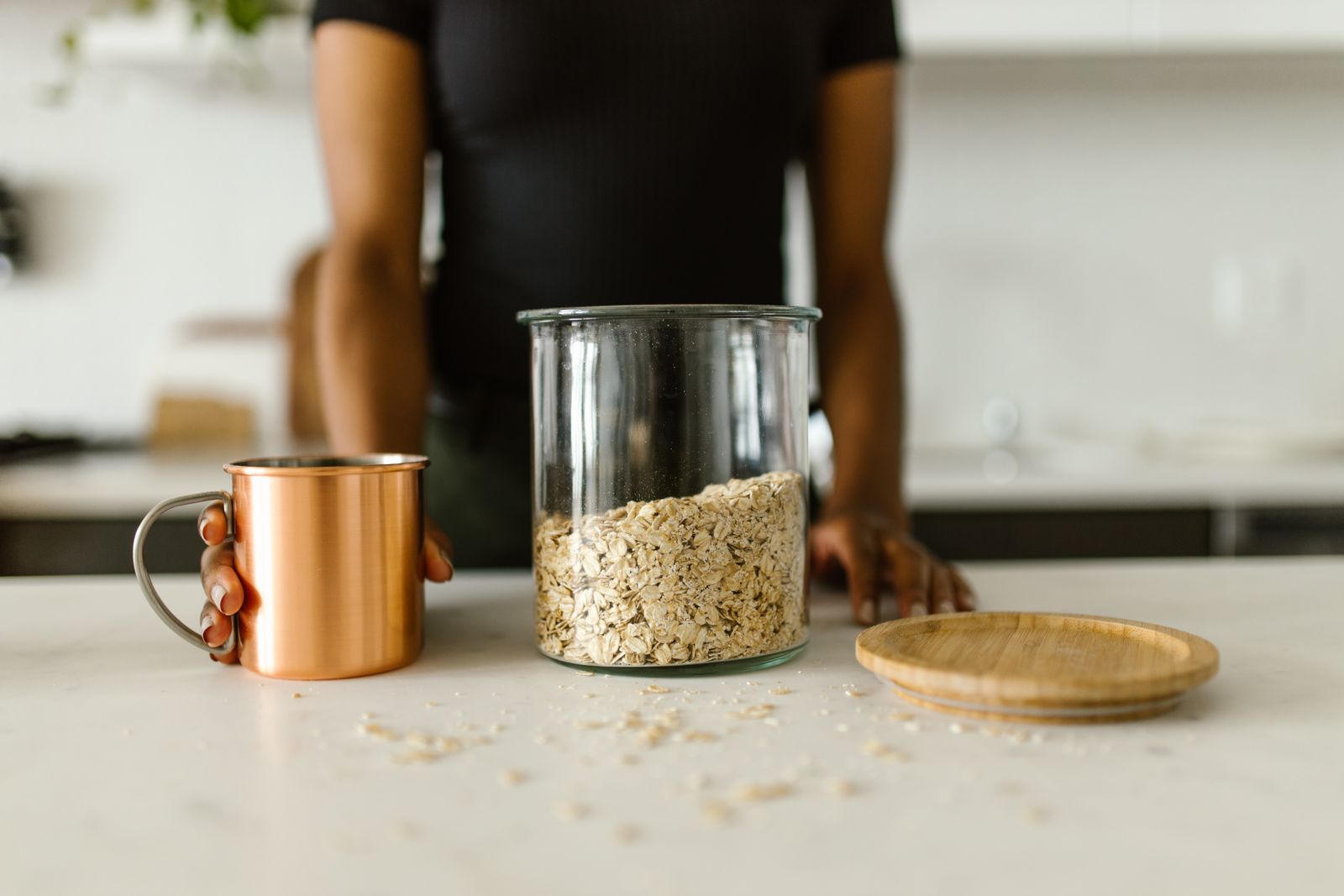
Worth knowing about oats in particular. Quick oats are crushed so fine that your body is spared the job of munching and crunching them down, which is why they behave very differently from rolled or steel cut oats. Intact oats cost you an extra minute and often less money. That is a simple little switch with real staying power behind it.
Easy protein at breakfast, in order of how little effort it takes: Greek yoghurt, a cold boiled egg cooked the night before, tinned fish on toast, milk on cereal, scrambled or hard boiled eggs, a spoon of nut butter.
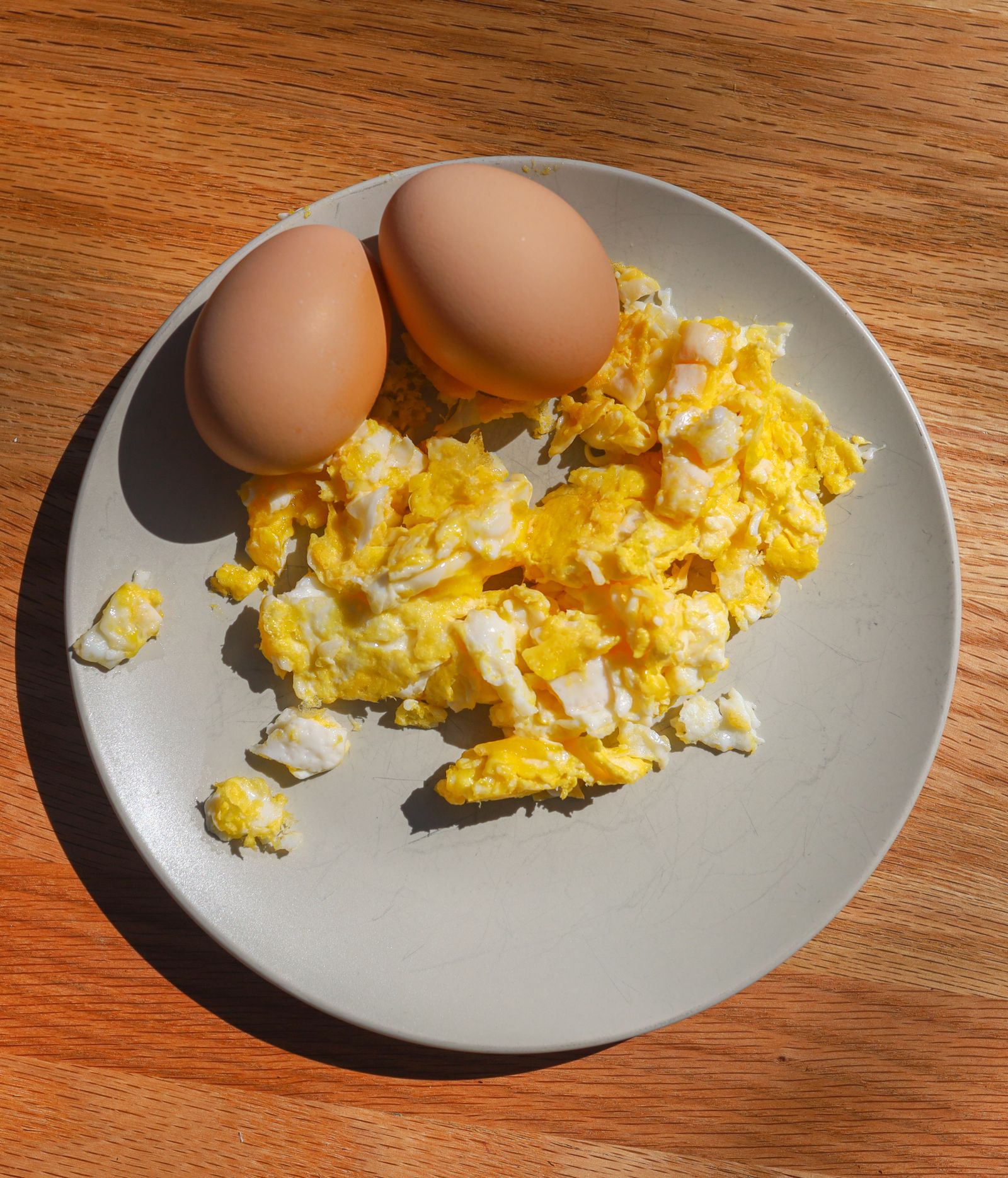
One food safety note for the first trimester, since breakfast is where it tends to bite. Eggs want to be cooked until both the white and the yolk are firm, so the soft and runny versions are worth skipping while you are pregnant. Cold smoked salmon and soft cheeses are on the list as well. The full Australian guide is in what not to eat when pregnant.
The coffee question, counted in shots
You do not have to give up coffee. MotherSafe, the medicines in pregnancy service at the Royal Hospital for Women, states that small amounts of caffeine are considered safe in pregnancy and that the recommended limit in Australia is a maximum of 200 milligrams a day.
The bit that trips people up is arithmetic rather than principle. Three cups of instant, or one to two espresso style coffees, or four cups of medium strength tea will each take you to that limit. A large flat white from a cafe is commonly three shots on its own, which can be your whole day in one cup. So if you have a large coffee on the way to work and a bought iced coffee in the afternoon, you are having four or five shots through the day without noticing.
Count the shots first. Then shrink the order, taper, or stop, whichever one you can actually live with. Moving to decaf after the first cup is the switch most women find painless.
The recipe: overnight oats for the morning you know will be bad
This is the breakfast I suggest most often in the first trimester, for one reason. It is made the night before, it is eaten cold, and it does not ask you to stand over a hot pan when you first get up. It is ready before the nausea gets a vote.
Serves two. Five minutes the night before.
- 1 cup rolled oats, not quick oats
- 1 cup milk
- Half a cup of Greek yoghurt
- 1 tablespoon chia seeds
- 1 grated apple, or 1 mashed ripe banana
- 1 cup berries, fresh or frozen
- 1 tablespoon crushed walnuts, optional
Stir the oats, milk, yoghurt, chia and fruit together in a container or in two jars. Lid on, into the fridge overnight. In the morning top with the berries and the walnuts. It keeps for two days.
The dietitian’s note. Rolled oats rather than quick oats, so your body does the work of breaking them down. The oats bring iron and fibre, the berries bring the vitamin C that helps you absorb that iron, the milk and yoghurt bring calcium and iodine, and the yoghurt and chia bring the protein that gives the whole thing staying power. The walnuts are there for omega-3. It is cold, which means almost no smell, and it is already made, which on a bad morning is the entire point. Designed with the first trimester in mind, as general education rather than advice for anyone’s particular situation.
There are more in recipes for pregnancy.
When it is worth seeing a pregnancy dietitian
Most women do not need me in order to sort out breakfast. The ones I can genuinely help in the first trimester:
- Nausea or aversion has taken out whole food groups, and eating has become the problem in its own right.
- You are taking four or five supplements and are quietly worried you have overdone it.
- Your iron or B12 was low coming in and tablets alone have not shifted it.
- You eat gluten free, vegetarian or vegan, and want the iodine, iron and B12 covered on purpose.
- You have a history of restrictive eating, and being told to simply eat more is landing badly.
What you leave with is simpler than people expect. A good baseline diet, two or three small switches you can manage on a bad week, and a shorter list of rules than you arrived with. I work alongside your GP and midwife rather than over the top of them, and I write back to whoever referred you.
I am a pregnancy dietitian in Brisbane, consulting across Australia by telehealth. If a short chat would help, the pregnancy consultation page is the place to start.
Kat xx
General information only, and not advice for your own circumstances. Sources: NHMRC Nutrient Reference Values; Food Standards Australia New Zealand mandatory fortification standards; RANZCOG Pre-Pregnancy Counselling (C-Obs 3a); SOMANZ Guideline for the Management of Nausea and Vomiting in Pregnancy; MotherSafe, Royal Hospital for Women.