There is a nutrient that comes up in almost every pregnancy consultation I have once someone starts reading, and almost never comes up before that. It is choline. It sits in the same conversation as folate and iodine in the research, and nowhere near them in the pharmacy aisle.
If you are taking a prenatal supplement and assuming it has you covered, this is the gap worth knowing about.
What choline is, in plain terms
Choline is an essential nutrient. Your body makes a small amount and cannot make enough, so the rest comes from food. It is used in the development of a baby’s brain and spinal cord, and in the structure of every cell membrane your body builds during pregnancy, which in pregnancy is a great many of them.
In Australia and New Zealand the Adequate Intake for choline is 440 mg a day in pregnancy and 550 mg a day while breastfeeding. So the requirement goes up at exactly the point when nausea, aversions and a shrinking appetite make eating harder.
I want to be careful here. Choline is not a treatment and it is not a guarantee of anything. It is a nutrient with an intake target, like iron or iodine, and the useful question is a practical one: are you likely to be reaching it.
The Australian numbers, and they are not reassuring
Most of what circulates about choline online is American. The Australian picture has actually been measured.
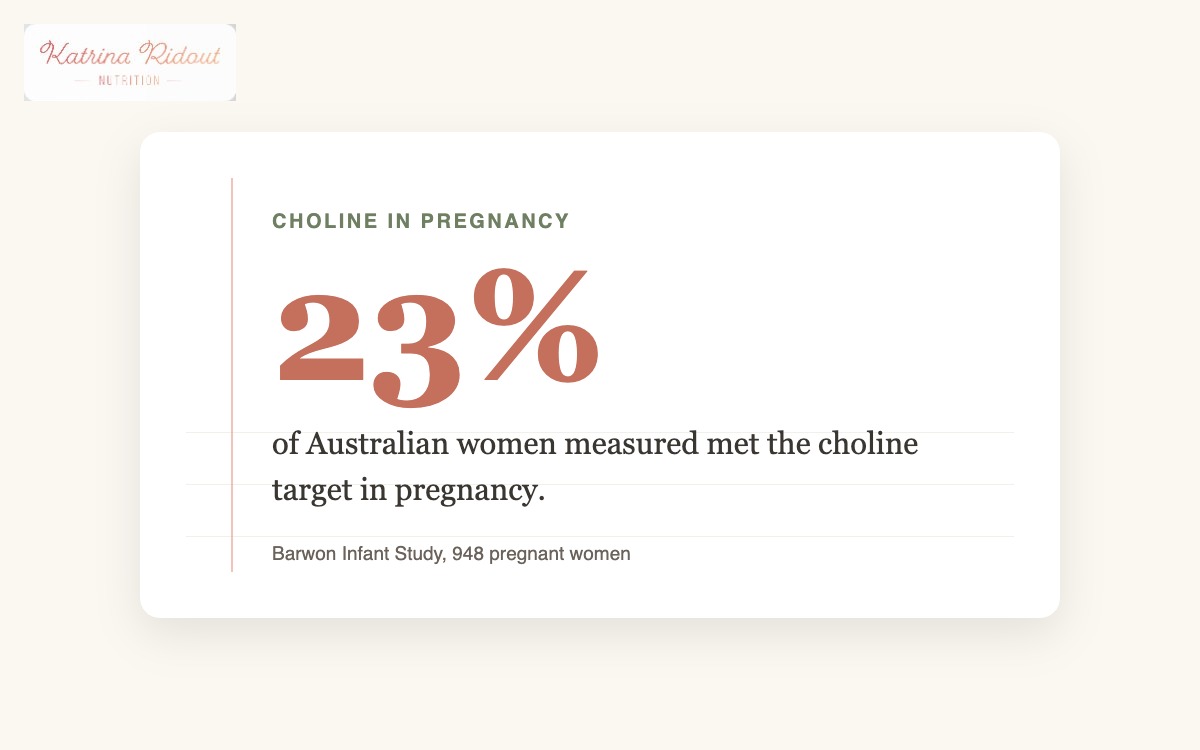
The Barwon Infant Study looked at dietary choline intake in 948 Australian pregnant women. Mean intake was 372 mg a day. Only 23 per cent reached the 440 mg Adequate Intake.
So roughly three in four Australian women in that cohort were eating below the target. Not dangerously, not dramatically, just consistently under. That is the shape of most nutrition gaps in pregnancy, and it is why it goes unnoticed.
Why your prenatal probably does not cover it
Here is the part that surprises people. Standard Australian pregnancy multivitamins often contain no choline at all, and those that do typically contain around 50 to 100 mg, which is a small fraction of a 440 mg target.
This is not a conspiracy and it is not the manufacturers being careless. Choline is physically bulky. Fitting a meaningful dose into a capsule that already carries folate, iron, iodine and vitamin D is genuinely difficult, and something has to give. Choline is usually what gives.
The practical consequence is simple and worth saying plainly: for most women, almost all of their choline will come from food. Checking the label on your own prenatal is a thirty-second job and most people have never done it.
Where choline actually comes from
In the Australian cohort, dairy and eggs together contributed about 22 per cent of total choline intake, and were the leading contributors. Baked products, vegetables, red meat, poultry and fruit made up most of the rest.
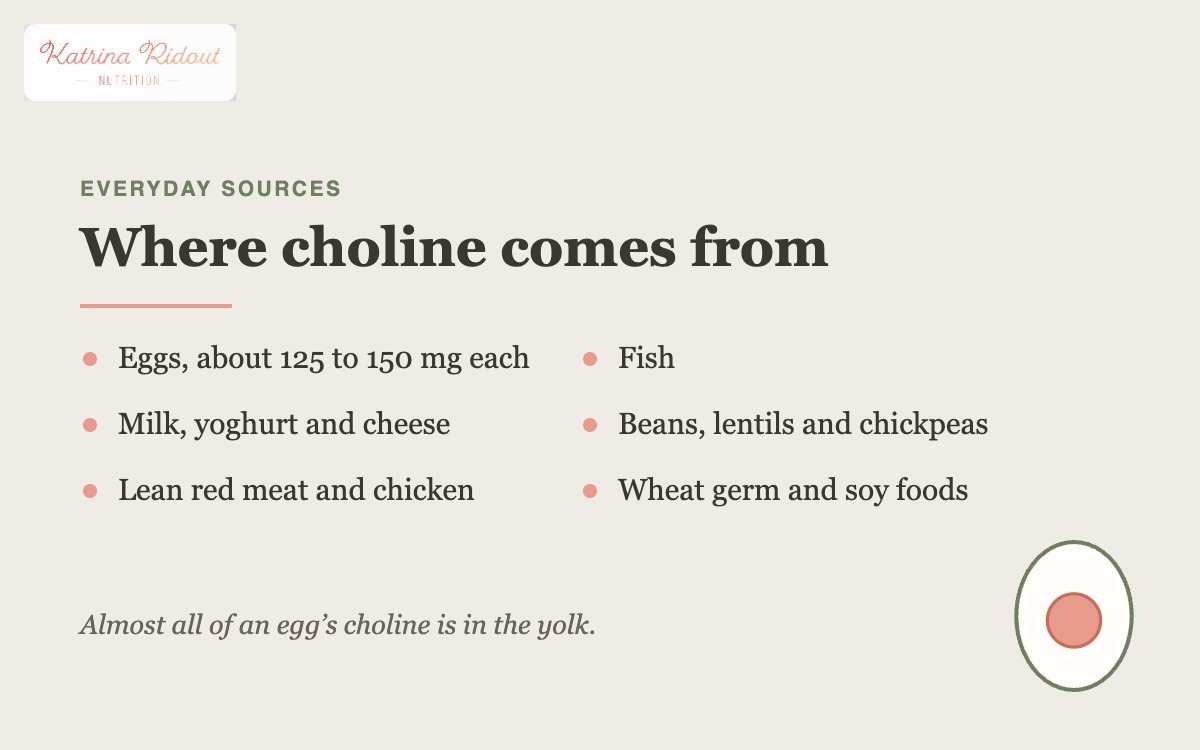
Eggs are the standout. One large egg provides roughly 125 to 150 mg of choline, and almost all of it is in the yolk. Two eggs gets you a long way toward 440 mg before anything else on the plate is counted.
Other useful everyday sources:
- Lean red meat and chicken
- Fish
- Milk, yoghurt and cheese
- Beans, lentils and chickpeas
- Wheat germ and soy foods
Notice what is not on that list: anything unusual, expensive, or bought from a wellness website. This is ordinary food.
What this looks like on an actual weeknight
The honest version of this advice is not “eat more choline.” It is “eat eggs more often than you currently do, and do not throw away the yolk.”
A two-egg breakfast, a two-egg dinner once or twice a week, dairy across the day and meat or legumes at the main meal is the kind of pattern that closes most of the distance between the 372 mg average and the 440 mg target, without anything that feels like a diet.
If eggs are exactly what you cannot face right now, which is extremely common in the first trimester, that is worth talking through rather than pushing past. Aversions are real, they are temporary, and there are other routes to the same intake.
When it is worth getting individual advice
Most people do not need a dietitian to eat more eggs. It is worth getting individual advice when:
- You do not eat eggs, dairy or animal foods, which removes most of the dense sources at once
- Nausea or aversions are limiting what you can keep down
- You are managing another condition alongside pregnancy, such as gestational diabetes, where meal composition is already being juggled
- You are taking a prenatal supplement and genuinely do not know what is in it
This is the sort of thing covered in pregnancy nutrition support with an Accredited Practising Dietitian, where the point is to look at what you are actually eating rather than to hand you a list.
The short version
Choline has an Australian intake target of 440 mg a day in pregnancy. Roughly three in four Australian women measured were under it. Most prenatal supplements contribute little or nothing. Eggs are the densest everyday source at around 125 to 150 mg each, and the yolk is where it lives.
That is the whole thing. It is a nutrient worth knowing the name of, and it is not worth losing sleep over.
If you would like to go through your own eating with someone, you can book a 15 minute callback here: book a 15 minute investigative callback.
Kat
Katrina Ridout, Accredited Practising Dietitian (APD)
Sources
- Barwon Infant Study, choline intake in Australian pregnancy: European Journal of Nutrition
- Australian and New Zealand Nutrient Reference Values, Adequate Intake for choline