If you are going through IVF, you have probably discovered that everyone has an opinion on what you should eat. Pineapple core after transfer. No coffee ever again. A supplement for every letter of the alphabet. It is a lot, and most of it is noise. As an IVF dietitian supporting Adelaide women online, Kat Ridout hears the same question in almost every first call: what actually makes a difference? This guide covers what the evidence supports, what you can leave behind, and how nutrition support can work alongside the care you are already getting from your fertility clinic.
Why nutrition matters during IVF
The eggs collected in your cycle began maturing around three months earlier, and sperm take roughly the same time to develop. That means the food you eat in the months before and during treatment is part of the environment your eggs and sperm develop in. Nutrition is never the whole picture, and it is not a guarantee of any outcome, but it is one of the few parts of an IVF cycle that is genuinely in your hands.
Research in this area has grown quickly. Observational studies have linked Mediterranean-style eating patterns with better markers across fertility treatment, and individual nutrients such as folate, omega-3 fatty acids and choline all play defined roles in egg maturation, early cell division and neural tube development.
The eating pattern the evidence supports
No single food makes or breaks a cycle. What matters is the overall pattern, and the pattern with the most consistent evidence behind it is Mediterranean-style eating: plenty of vegetables and fruit, wholegrains, legumes, nuts and seeds, oily fish, extra virgin olive oil, and moderate amounts of dairy and eggs. It is not restrictive, it is not expensive, and it does not ask you to give up entire food groups while you are already under enough pressure.
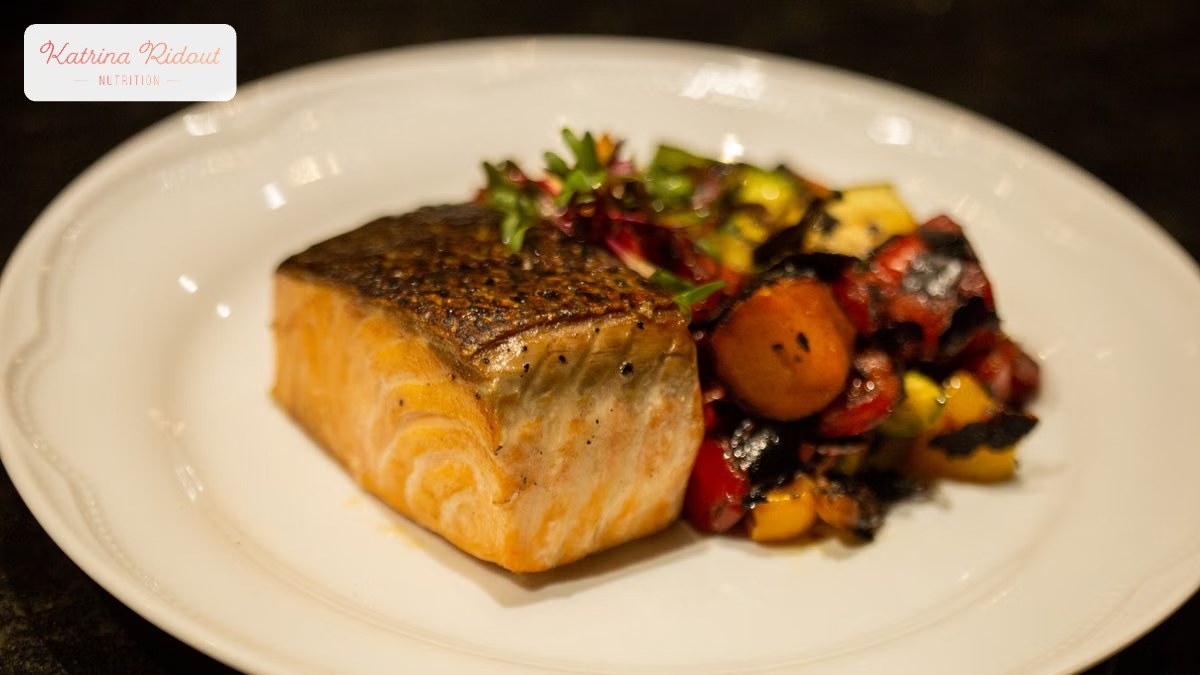
Simple meals like baked salmon with colourful vegetables tick so many boxes during IVF preparation.
Foods worth focusing on
Leafy greens and legumes for folate
Folate supports the rapid cell division that happens from the moment of fertilisation. Spinach, rocket, broccoli, lentils and chickpeas are all rich sources, and they come packaged with fibre that supports steady blood sugar as well.
Oily fish for omega-3s
Salmon, sardines and mackerel provide long-chain omega-3 fatty acids, which sit in the membranes of developing eggs and support a healthy inflammatory balance. Two to three serves a week of lower-mercury oily fish is a practical target for most women.
Eggs for choline
Choline is one of the quiet achievers of early pregnancy nutrition, supporting neural tube development and cell membranes. Whole eggs are the easiest source in an Australian diet, and they bring quality protein with them.
Wholegrains and extra virgin olive oil
Swapping refined carbohydrates for wholegrains supports steadier blood sugar and insulin, which matters for egg quality, especially if PCOS is part of your story. Extra virgin olive oil as your main fat rounds out the pattern.
What about the two-week wait?
The fortnight between transfer and your pregnancy test is when the myths get loudest. Here is the honest answer: there is no food that makes an embryo implant. Pineapple core, Brazil nuts and warm socks are rituals, not evidence. If they bring you comfort, they are harmless. What actually helps is simply continuing the same pattern you built before transfer: regular meals, plenty of colour, enough protein, and good hydration. Your job in the two-week wait is to look after yourself, not to eat perfectly.
Supplements: worth it or not?
A few supplements have a clear place. Folic acid is recommended for at least a month before conception and through early pregnancy. Iodine supports thyroid function and a baby’s brain development, and is included in most Australian pregnancy multivitamins. Vitamin D is worth checking with your GP and supplementing if you are low. Beyond that, the picture gets murkier, and stacking a dozen expensive supplements is rarely money well spent. A dietitian can look at your diet, your bloods and your history and tell you what is worth taking and what you can put back on the shelf.
What to limit
Alcohol is best avoided during treatment. Keep caffeine to around one to two coffees a day. Go easy on deep-fried foods and processed meats, and choose lower-mercury fish (salmon and sardines over flake and swordfish). None of this needs to be perfect. The goal is a pattern you can actually live with through a demanding season of life.
Small, steady changes in your own kitchen are where the real progress happens.
IVF nutrition support in Adelaide, wherever you are in SA
South Australia has excellent fertility clinics, and if you are cycling at a clinic like Repromed you are in experienced hands medically. What is often missing is dedicated nutrition support that walks the whole journey with you, from preparing for a cycle through the two-week wait and into pregnancy itself, including gestational diabetes support if that becomes part of your path.
That is the gap Kat fills. Kat Ridout is an Accredited Practising Dietitian with a Graduate Certificate in Research in prenatal nutrition, and she works with women right across South Australia through telehealth. You book a time, you get a secure telehealth link, and you meet from your own kitchen table, whether that is in Adelaide, the Hills or the Riverland. Your plan is built around your history, your bloods and your treatment schedule, not a template.
If you are preparing for IVF or in the middle of a cycle and want nutrition support that backs your treatment, start with a conversation. Book a complimentary 15-minute call with Kat and work out the best next step together, with no pressure.
You can also see the full picture of how Kat works with women in South Australia, including what a package looks like and what it costs, on her fertility and pregnancy dietitian services for Adelaide page.
Kat works one to one on IVF nutrition in person in Milton, Brisbane, or by telehealth anywhere in Australia. See how her IVF nutrition service works.