If you have been given a diagnosis of PMOS, formerly known as PCOS, there is a reasonable chance somebody has already suggested inositol to you. A friend, a forum, an advertisement, or the shelf at the chemist.
It is the most common supplement question I am asked as a fertility dietitian in Brisbane. So this piece is about what the evidence actually says, and the honest answer is more interesting than either of the two versions you usually hear.
General information only, and not advice for your own circumstances.
First, the name changed
In May 2026 the condition most people know as PCOS was formally renamed Polyendocrine Metabolic Ovarian Syndrome, or PMOS. The change was announced on 12 May 2026 and published in The Lancet the same day, after fourteen years of work involving more than fifty patient and professional organisations, including the Endocrine Society. It was led by Professor Helena Teede, whose group is based at Monash University in Melbourne, so this is a largely Australian piece of work.
The reasoning is worth knowing, because it explains something many women find baffling about their own diagnosis. The old name pointed at ovarian cysts, and the review found no increase in abnormal cysts on the ovary. A name pointing at the wrong feature contributed to missed diagnoses and to care that did not fit. The new name points at the hormonal and metabolic picture instead.
The condition affects roughly one in eight women, more than 170 million worldwide. There is a three-year transition and the new name will be fully implemented in the 2028 update of the international guideline, so you will see both names for a while and your own records may carry either.
What the guideline actually says about inositol
The document that matters is the 2023 International Evidence-based Guideline for the Assessment and Management of PMOS. Here is what it says, close to verbatim.
Inositol, in any form, could be considered, based on individual preferences and values. That recommendation carries a very low certainty of evidence. The guideline notes limited harm, some potential for improvement in metabolic measures, and limited clinical benefit including for ovulation, excess hair growth and weight.
It also says metformin should be considered over inositol for excess hair growth and central weight, which is a prescribing decision for your doctor rather than a nutrition one.
And then the line that matters most in a chemist aisle. Specific types, doses or combinations of inositol cannot currently be recommended, because the quality of evidence is not there. That includes the particular ratios you will see advertised on the front of a box.
The systematic review behind those recommendations pooled 30 randomised trials and about 2,230 participants, at an average of roughly 36 people per treatment arm. Myo-inositol or D-chiro-inositol may help some metabolic measures, D-chiro-inositol may help ovulation, and inositol may make no difference to the rest. Myo-inositol probably causes fewer gut side effects than metformin. The reviewers described the evidence as limited and inconclusive, and pointed to shared decision making rather than a blanket yes or no.
What that means if you are standing in the chemist
It means inositol is a reasonable thing to discuss and a poor thing to pin your hopes on. Could be considered is not the same as recommended, and a very low certainty of evidence is the guideline saying honestly that it does not yet know.
Three practical things follow.
Tell your doctor if you are taking it. The guideline asks this directly of anyone using inositol or other complementary therapies, and it is a fair ask of any supplement.
Know that supplements sit under different rules from medicines. The guideline makes the point that the regulatory status and quality control of inositol, like other nutrient supplements, can differ from those for pharmacological products.
Weigh the cost against the evidence. If it suits you and you can afford it, that is a legitimate decision made on your own preferences and values, which is exactly the frame the guideline uses. If it is one of five bottles nobody has ever totalled, that is worth a conversation.
The diet question, and the answer nobody sells
This is the part I most want women with PMOS to hear, because it is the opposite of what the internet sells.
The guideline states that there is no evidence to support any one type of diet composition over another, across weight, metabolic, hormonal, reproductive and psychological outcomes. Not low carbohydrate. Not keto. Not dairy free. Not gluten free.
What it says instead is that any diet composition consistent with population guidelines for healthy eating will have health benefits, and that unduly restrictive and nutritionally unbalanced diets should be avoided.
Which makes the honest nutrition answer for PMOS ordinary food, enough of it, in a pattern you can actually keep up. That is a much worse product and a much better answer.
Movement, and the part about weight

The guideline recommends lifestyle intervention for everyone with PMOS, aimed at metabolic health. For adults that means at least 150 to 300 minutes of moderate intensity activity a week, and it adds that no one type or intensity of exercise has been shown to beat another.
Two lines in that section deserve more attention than they get. There are benefits to a healthy lifestyle even in the absence of weight loss. And healthy lifestyle and weight management appear equally effective in PMOS as in the general population, which runs against the common belief that the condition makes ordinary approaches pointless.
Do prenatal vitamins help with PMOS
This one comes up often, usually from women who are trying to conceive and wondering whether their prenatal is quietly doing a second job.
A prenatal supplement is not a treatment for PMOS. What the guideline does say is that preconception planning should include folate supplementation, at a higher dose for women with a BMI above 30, and that prenatal vitamin supplementation should begin alongside ovulation induction therapy where that is part of your care.
So the prenatal is doing pregnancy work rather than PMOS work, and it is still worth getting right. Bring the actual bottle to your appointment rather than the name of it. Iodine is missing from some pregnancy multivitamins and iron amounts vary a good deal between them.
If fertility is the reason you are reading this, the fertility nutrition page sets out how I work, and there is a separate page on nutrition through IVF.
A tray bake for a PMOS week
Since the guideline is explicit that no single diet composition wins, this is built on ordinary population-guideline eating rather than on a restriction. It is a weeknight tray, it makes good lunches, and it is the sort of thing I actually cook.
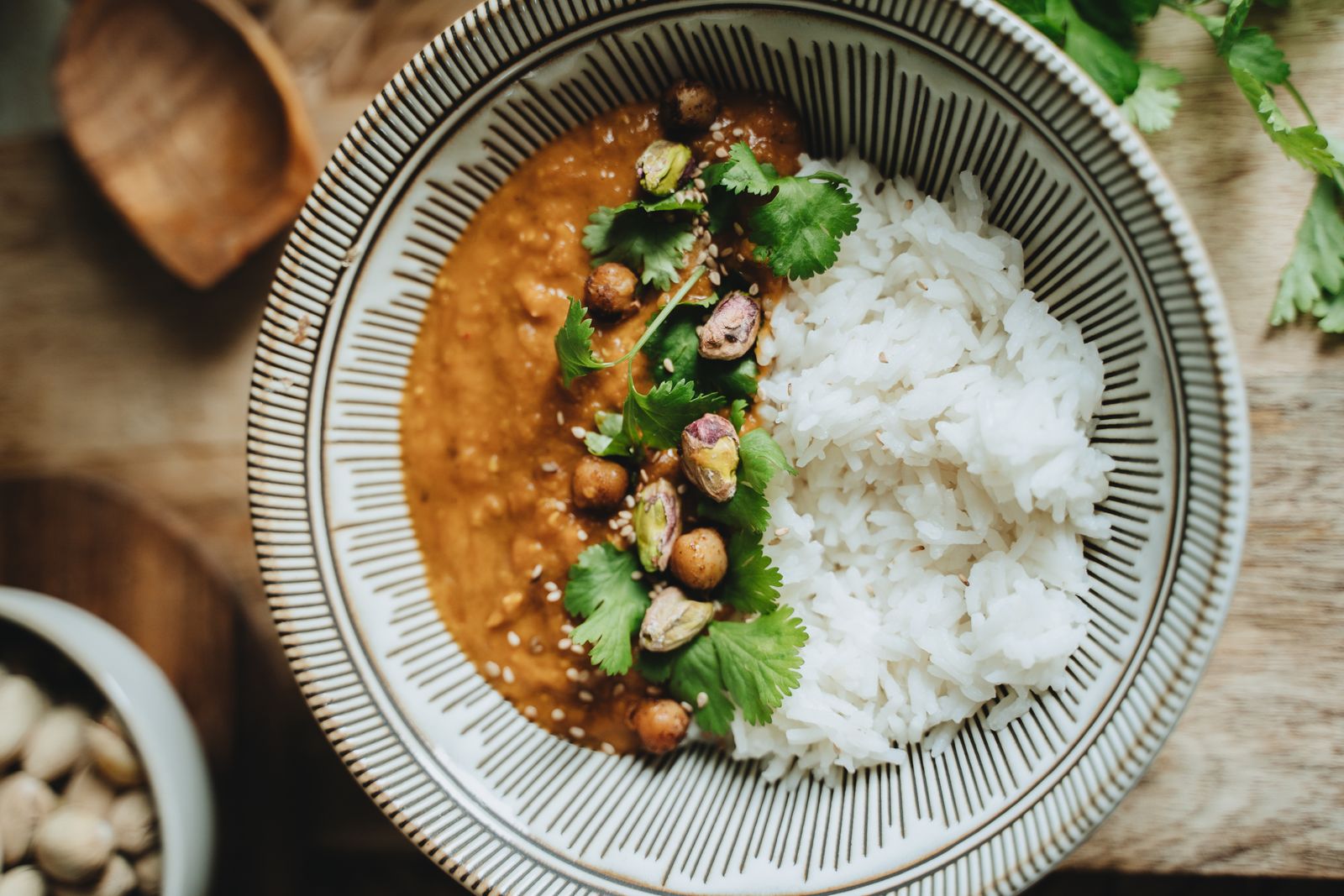
Warm chickpea, pumpkin and barley tray with lemon tahini. Serves four. About 15 minutes of work and 35 in the oven.
Ingredients. 700 g pumpkin, peeled and cut into 3 cm pieces. 1 red onion, cut into wedges. 2 tablespoons olive oil. 1 teaspoon ground cumin. 1 cup pearl barley. 400 g tin of chickpeas, drained and rinsed. 2 tablespoons tahini. Juice of 1 lemon. 1 clove garlic, crushed. 2 to 3 tablespoons water. A large handful of flat leaf parsley, torn. 50 g feta, optional.
Method. Heat the oven to 200 degrees. Toss the pumpkin and onion with one tablespoon of the oil and the cumin on a large tray and roast for 30 minutes. While that happens, simmer the barley in plenty of water for 25 to 30 minutes until tender, then drain. Add the chickpeas to the tray for the last 10 minutes so they dry out and catch a little. Whisk the tahini, lemon juice, garlic, the remaining oil and the water until it pours. Tip the barley onto the tray, fold everything together, spoon the dressing over, and scatter the parsley and the feta.
The dietitian note. Designed with PMOS in mind, as general education rather than advice for anyone in particular. The barley and the chickpeas carry most of the fibre, the tray does the work while you do something else, and there is nothing in it you have to buy from a health food shop. It keeps three days in the fridge and is better cold than it has any right to be.
When an APD is worth seeing for this
Not everybody with PMOS needs a dietitian. The presentations where I think the appointment earns its place are these.
When you have been told to lose weight and given no method, or a method that has already failed twice.
When the eating pattern has narrowed, because a long run of rules has taken food groups out and nothing went back in.
When there are four or five supplements and nobody has added them up.
When you are trying to conceive and want the nutrition side of preconception done properly alongside your medical care.
And when a previous period of restrictive eating makes the usual advice land badly and in need of translating.
I am Katrina Ridout, an Accredited Practising Dietitian (APD) working in fertility, pregnancy and postpartum nutrition. I am a PMOS dietitian in Brisbane and I consult across Australia by telehealth, so being outside a capital city is not a barrier. I work alongside your GP or specialist rather than over the top of them.
General information only. Nothing here replaces individual advice from your own treating team.